Grid linesGrid lines
Evoqins - Blog

Mobile app development7 mins read

Stock Trading App Development: Benefits, Challenges, & Solutions

Published on: Jun 16, 2026

blog cover image
Table of contents
IntroductionWhy now? The perfect time to invest in a stock trading appWhy businesses should develop a stock trading app?Market trends and global growth of online tradingEmerging trends in stock trading app developmentCore features of a stock trading applicationDevelopment process of stock trading app for stock brokerage businessesHow to overcome the challenges to develop stock trading apps?How Evoqins can help you build a stock trading app for your business?Why choose Evoqins for stock trading app development?ConclusionFrequently asked questions
Share this article:

Introduction

The landscape of stock trading has seen a drastic growth in recent years, moving away from traditional brokerage firms to mobile-first trading platforms. The rise of commission-free trading, fractional investments, and real-time analytics has made stock trading apps indispensable tools for both seasoned investors and newcomers.

For businesses, this evolution presents a significant opportunity. Whether you are a fintech startup, a brokerage firm, or a financial institution, launching a stock trading app can open new revenue streams, increase customer retention and customer engagement, and establish your brand as a major player in the digital trading revolution.

Why now? The perfect time to invest in a stock trading app

  • Surging retail investor interest: With increasing financial literacy and accessibility, more individuals are actively trading and investing.
  • Regulatory advancements: Governments and regulatory bodies like SEBI (India) have introduced clear frameworks for digital trading, reducing entry barriers.
  • Technology-driven disruption: AI-driven analytics, robo-advisors, and social investing are changing how people trade. Businesses that innovate now will gain a competitive edge.

Let’s explore why businesses should invest in stock trading app development, the key features and tech stack, and how Evoqins can help you build a next-gen trading platform.

Why businesses should develop a stock trading app?

Investing in a stock trading app is more than just a technological upgrade—it’s a strategic move that can unlock new revenue streams, expand customer engagement, and future-proof your business in the competitive fintech landscape. Here’s why businesses should consider developing their trading platform.

why businesses should develop a stock trading app

⇒ Expanding revenue streams: A stock trading app creates multiple monetization opportunities beyond just transaction fees. Businesses can generate revenue through:

  • Brokerage fees & commissions
  • Subscription-based premium features
  • Margin trading & lending services
  • Partnerships & API monetization

⇒ Increased customer engagement & retention: Stock trading is a high-engagement activity. By offering a seamless, feature-rich trading experience, businesses can enhance user retention and drive loyalty. Features like:

  • Real-time market updates to keep traders informed.
  • Personalized investment recommendations using AI-driven insights.
  • Automated alerts & portfolio tracking for improved decision-making.

⇒ Market expansion & brand authority: A well-developed trading app helps financial businesses tap into a larger audience, including retail investors, day traders, and institutional investors. Owning a stock trading platform enhances brand authority, positioning your business as a trusted financial services provider.

⇒ Monetization beyond trading: Besides direct trading revenue, businesses can leverage data insights to offer additional financial products:

  • Mutual funds & ETFs – Allowing users to diversify their investments within the same platform.
  • Robo-advisory services – Providing AI-driven investment suggestions based on risk tolerance.
  • Financial planning tools – Helping users manage their portfolios effectively.

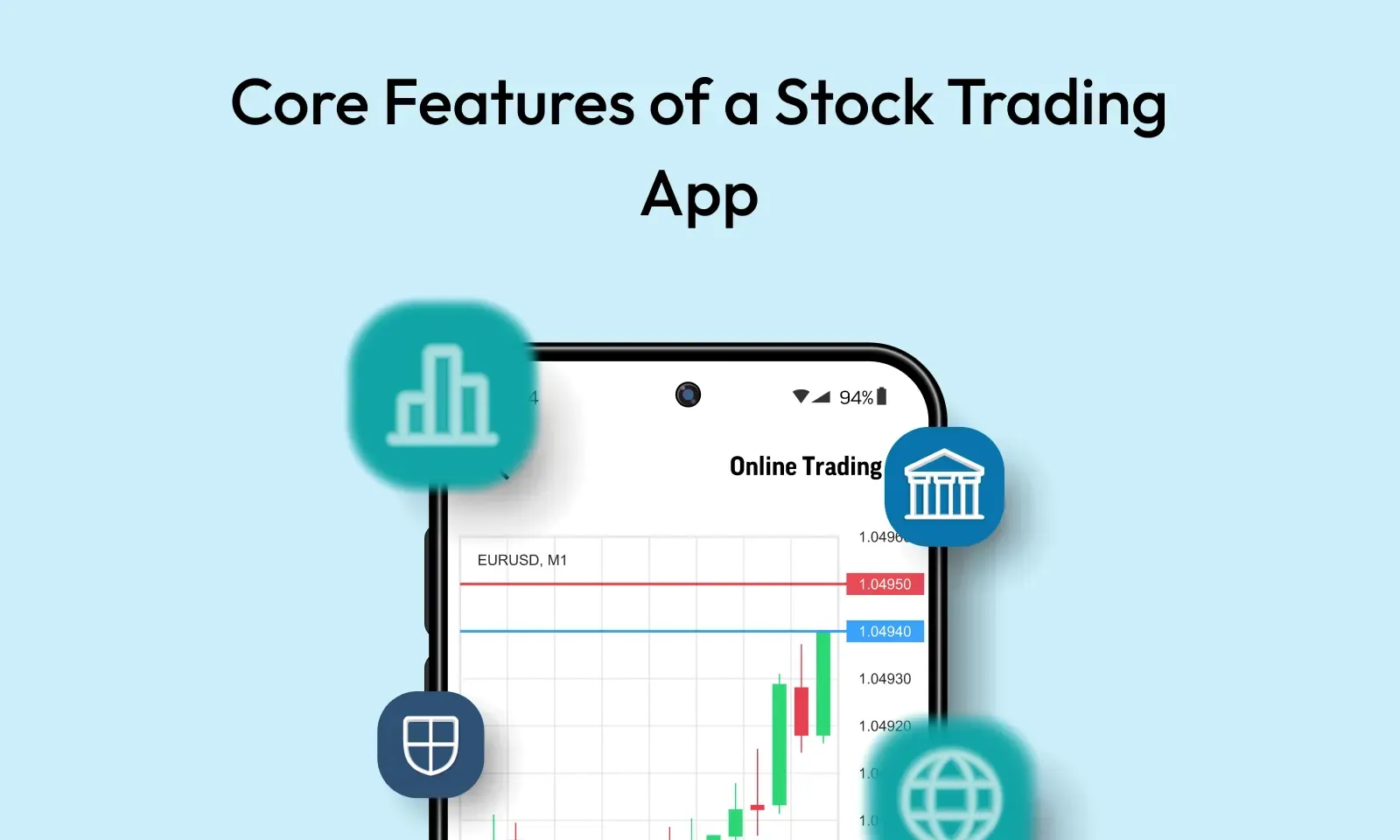
Core features of a stock trading application

Developing a stock trading app requires a robust feature set that ensures seamless trading, real-time market access, top-tier security, and user-friendly navigation. Below are the essential features every successful stock trading app must have:

Core features of stock trading app

⇒ Seamless onboarding & KYC verification

  • Quick and compliant account registration with multi-factor authentication.
  • Automated KYC (Know Your Customer) process with Aadhaar-based eKYC (India) or Social Security/Tax ID verification (U.S.).
  • AML (Anti-Money Laundering) compliance for regulatory adherence.

⇒ Real-time market data & stock charts

  • Live stock price updates from exchanges like NSE and BSE.
  • Technical indicators & charting tools (candlestick patterns, moving averages, RSI, etc.).
  • Customizable watchlists to track preferred stocks.

⇒ Instant order execution & portfolio management

  • Multiple order types (market, limit, stop-loss, GTT).
  • Seamless trade execution with low latency and high reliability.
  • Portfolio tracking dashboard with real-time profit/loss insights.

⇒ AI-powered trading insights & robo-advisory

  • AI-based stock recommendations using market sentiment analysis.
  • Robo-advisory services for automated portfolio management.
  • Stock screeners help users find trading opportunities based on parameters like P/E ratio, volume, and volatility.

⇒ Alerts, notifications & personalized insights

  • Price alerts & trade execution notifications via push messages, SMS, or email.
  • AI-powered personalized news feeds related to a user’s portfolio holdings.
  • Market event alerts (earnings reports, IPO launches, stock splits).

⇒ Secure transactions & compliance adherence

  • Bank-grade security with end-to-end encryption.
  • Two-factor authentication (2FA) via OTP, biometric authentication, or authenticator apps.
  • Regulatory compliance with SEBI for legal trading operations.

⇒ Seamless fund transfers & payment integrations

  • Instant UPI, bank transfer, and card payments for deposits/withdrawals.
  • Integration with digital wallets like Google Pay, Apple Pay, and Paytm.
  • Automated tax reporting & P&L statements for tax compliance.

⇒ Fractional trading & advanced investment options

  • Fractional share investing for accessibility to high-value stocks. Derivatives & options trading for advanced traders.
  • Mutual fund & ETF investments within the same platform.

⇒ Multi-platform accessibility

  • Mobile app (iOS & Android) for on-the-go trading.
  • Web platform & desktop trading terminal for professional traders.
  • API access for algorithmic traders to integrate custom strategies.

Development process of stock trading app for stock brokerage businesses

Building a stock trading app involves multiple stages, from conceptualization to deployment. A well-structured development process ensures regulatory compliance, security, and a seamless user experience. Below is a step-by-step breakdown of how to develop a stock trading app, along with an estimated timeline.
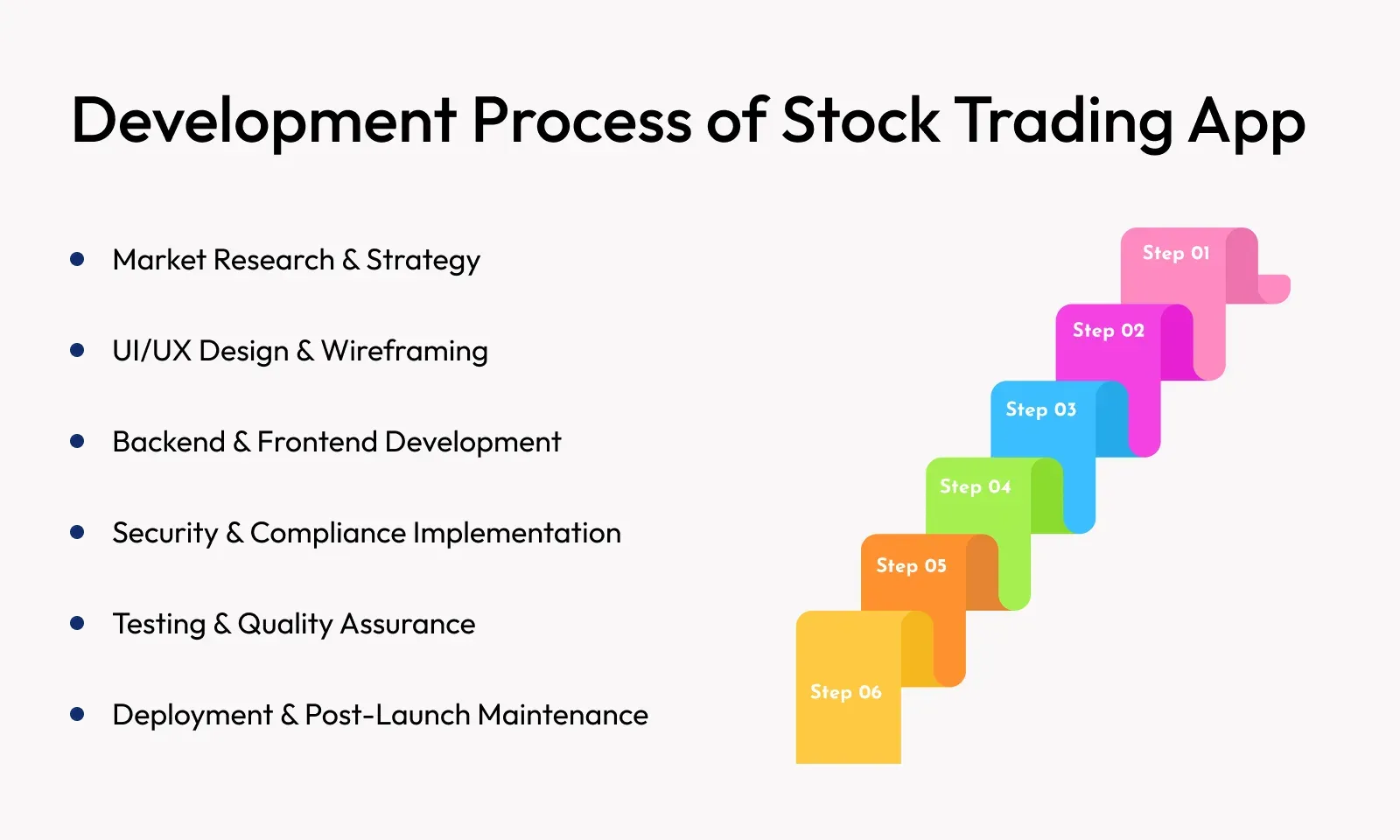
Development process of stock trading app

Step 1: Market research & strategy
Before diving into development, it's crucial to analyze the target audience, competition, and regulatory requirements. Key activities:

  • Identifying user needs (retail traders, institutional investors, or both).
  • Studying competitors like Zerodha, Upstox, Groww, Robinhood, etc., to understand their strengths.
  • Ensuring compliance with SEBI (India) regulations.
  • Choosing the monetization model (commission-based, subscription, or hybrid).

Step 2: UI/UX design & wireframing
A stock trading app must offer a clean, intuitive, and responsive design for both beginners and professional traders. Key activities:

  • Creating wireframes and user flow diagrams.
  • Designing a minimalist, clutter-free UI with easy navigation.
  • Incorporating dark mode, high-contrast charts, and real-time market data visualization.
  • Ensuring mobile and web responsiveness for multi-platform accessibility.

Step 3: Backend & frontend development
The core development stage involves integrating trading engines, APIs, payment gateways, and security layers. Key activities:

  • Building a secure and scalable architecture with Node.js, Java (Spring Boot), or Python (Django/FastAPI).
  • Integrating market data APIs (Alpha Vantage, Bloomberg, Yahoo Finance).
  • Implementing real-time trading order execution with ultra-low latency.
  • Developing secure authentication (OAuth, 2FA, biometric login).
  • Creating a React Native (cross-platform) or Swift/Kotlin (native) mobile app.
  • Implementing real-time stock charts, portfolio dashboards, and interactive trading UI.
  • Ensuring seamless connectivity with the backend for instant order execution.

Step 4: Security & compliance implementation
Since trading apps handle sensitive financial data, security and regulatory compliance are non-negotiable. Key activities:

  • Implementing AES encryption for transactions.
  • Enforcing SEBI regulations, AML compliance, and secure KYC verification.
  • Setting up real-time fraud detection and risk monitoring.
  • Conducting penetration testing and vulnerability assessments.

Step 5: Testing & quality assurance
A stock trading app must function flawlessly under high-load conditions while ensuring bug-free performance. Key activities:

  • Unit & integration testing to verify order execution, charting accuracy, and real-time data feeds.
  • Performance testing to ensure the app handles high trading volumes with ultra-low latency.
  • Security audits for running penetration tests to identify vulnerabilities.
  • Beta testing by releasing an MVP to a closed group of users for feedback.

Step 6: Deployment & post-launch maintenance
After launch, continuous monitoring and updates are essential to ensure high performance and user retention. Key activities:

  • Deploying the app on Play Store (Android) & App Store (iOS).
  • Monitoring system uptime and fixing any live issues.
  • Implementing new features based on user feedback.
  • Scaling infrastructure as the user base grows.

A well-planned development process ensures that your stock trading app is secure, fast, and feature-rich, giving users the best possible trading experience. Partnering with the right fintech development team can significantly reduce risks and accelerate your time-to-market.

How to overcome the challenges to develop stock trading apps?

Building a stock trading app is a complex process that involves technical, regulatory, and user experience challenges. Below are some of the most common challenges businesses face and strategies to overcome them.

How to overcome the challenges to develop stock trading app

⇒ Ensuring regulatory compliance: Stock trading apps must comply with financial regulations like SEBI (India). Non-compliance can lead to legal action or operational shutdowns.

  • Solution: Partner with legal and compliance experts from the start. Implement KYC (Know Your Customer) & AML (Anti-Money Laundering) verification as per regulations. Regularly update policies based on changing financial laws.

⇒ Security & fraud prevention: Trading apps handle sensitive financial data and are prime targets for cyberattacks, identity theft, and fraud.

  • Solution: Use AES encryption for data security. Implement multi-factor authentication (MFA) & biometric logins. Deploy real-time fraud detection systems to monitor suspicious transactions. Conduct regular security audits & penetration testing.

⇒ Handling high-traffic & low-latency trading: Stock trading requires real-time order execution, and delays can lead to financial losses for users. Apps must handle high trading volumes without lag.

  • Solution: Use a microservices architecture with scalable cloud solutions (AWS, GCP, or Azure). Implement low-latency APIs for stock market data and trade execution. Optimize database queries & caching mechanisms to reduce processing time. Stress test the app under high trading volumes before launch.

⇒ Providing accurate real-time market data: Users expect instant stock price updates, live charts, and financial news feeds. Delays or inaccuracies can erode trust.

  • Solution: Integrate reliable third-party market data APIs like Alpha Vantage, Bloomberg, NSE/BSE, and Morningstar. Use WebSockets instead of REST APIs for real-time data updates. Implement redundant data sources to avoid downtime if one provider fails.

⇒ Creating an intuitive user experience (UX): Many trading apps fail because they are too complex or unintuitive for new users. Balancing advanced features with simplicity is key.

  • Solution: Design an easy-to-navigate UI with a clutter-free dashboard. Offer customizable trading interfaces for beginners vs. advanced traders. Provide interactive tutorials, tooltips, and demo trading options.

⇒ Managing payment & withdrawal processing: Slow fund deposits and withdrawals frustrate users, leading to churn. Ensuring secure and fast transactions is critical.

  • Solution: Integrate multiple payment options (UPI, bank transfer, credit/debit cards, digital wallets). Enable instant withdrawals using pre-approved bank accounts. Use automated payout systems to reduce manual intervention.

⇒ Retaining users & reducing churn: With intense competition in fintech, users quickly switch to competitors if they don’t get a smooth experience or see added value.

  • Solution: Implement data-driven personalized investment recommendations. Offer loyalty programs, referral bonuses, and fractional investing. Continuously improve features based on user feedback and analytics.

Overcoming these challenges requires careful planning, the right technology stack, and strong compliance measures. Partnering with an experienced fintech development team can help mitigate risks and ensure a successful launch.

How Evoqins can help you build a stock trading app for your business?

Why choose Evoqins for stock trading app development?

At Evoqins, we specialize in fintech software development, helping businesses create secure, high-performance stock trading apps tailored to their unique needs. Whether you’re a stock brokerage, investment firm, or a fintech startup, our team has the expertise to deliver a feature-rich and scalable trading platform.

  • Deep fintech expertise: We have hands-on experience in building financial platforms, including mutual fund apps, investment platforms, and stock trading solutions.
  • Regulatory compliance & security: We ensure that your app meets SEBI regulations, integrating KYC/AML processes and bank-grade security measures.
  • Custom-tailored solutions: Whether you need a full-fledged trading app or a niche investment platform, we build solutions that match your business model and target audience.
  • AI-powered & real-time trading: We integrate AI-driven insights, robo-advisory features, and real-time stock market data to provide an exceptional trading experience.
  • End-to-end development: From strategy and design to development, testing, and deployment, we handle the entire development lifecycle.
  • Scalable & high-performance architecture: Our apps are designed to handle millions of trades per day, ensuring ultra-low latency and seamless order execution.

If you’re looking to develop a cutting-edge stock trading platform, Evoqins can help you bring your vision to life. Our expertise in fintech, AI, and secure trading solutions ensures a seamless and future-ready app.

Conclusion

The stock trading industry is evolving rapidly, with increasing demand for fast, secure, and user-friendly trading platforms. Businesses that invest in custom stock trading apps gain a competitive edge, offering their users a seamless trading experience while expanding revenue opportunities.

However, building a stock trading app comes with technical, regulatory, and security challenges. Choosing an experienced fintech development partner is crucial to ensure compliance, security, and scalability.

At Evoqins, we specialize in developing high-performance, regulation-compliant stock trading apps specifically developed to meet your business needs. Whether you are a brokerage, a fintech startup, or an investment firm, we help you build a secure, scalable, and AI-powered trading platform that meets industry standards.

Frequently asked questions

  1. How do we handle high-volume trading and ensure execution without delays?
    Trade execution is the backbone of any stock trading app. We make sure that your application can handle high volumes of live orders by leveraging cloud infrastructure with microservices architecture and using low-latency APIs for order execution. Additionally, we utilize data caching, real-time stock market feeds, and load balancing to ensure your platform remains fast and reliable even during peak trading hours.

  2. What features should we prioritize to attract both beginner and experienced traders?
    To reach a wide range of users, your stock trading app should offer a balance of simple features for beginner traders and advanced tools for professionals. Some of the key features include:

    • For beginners: Simple, intuitive UI/UX, demo trading, educational resources, and automated portfolio suggestions via robo-advisors.
    • For experienced traders: Advanced charting tools, real-time market data, technical indicators, customizable trading strategies, and advanced order types like stop-loss, limit, and GTT (Good Till Triggered). Offering fractional trading and social trading features can also enhance engagement and broaden your app’s appeal.
  3. What security parameters will be followed to protect our users' data and funds?
    Security is a top priority in any trading app. We implement bank-grade encryption (AES) for secure data transmission, use multi-factor authentication (MFA) for user access, and integrate biometric login for enhanced security. Additionally, we ensure that fraud detection systems are in place, and we conduct regular penetration testing to identify potential vulnerabilities. Regulatory compliance for data protection ensures that user information is handled securely according to local laws.

  4. What is the estimated time and cost to develop a fully functional stock trading app?
    The factors that should be considered when deciding the timeline for developing a stock trading application are the features and complexity of the platform. Typically, the development process considers phases like research, design, coding, testing, and deployment. Costs can vary based on the features, integrations, and customizations you require. We provide a detailed project proposal after understanding your specific needs and budget, ensuring full transparency throughout the development lifecycle.

  5. How can we ensure scalability as our user base grows?
    Scalability is crucial for handling increasing traffic and trading volume over time. We build your app on a cloud-based infrastructure (AWS, Google Cloud, Azure) with a microservices architecture to ensure that the app can easily scale horizontally as your user base grows. We also incorporate auto-scaling mechanisms, optimize database performance, and use load balancing to ensure the app can handle peak trading hours without performance degradation. It ensures that your platform can accommodate growth seamlessly.

Evoqins - Blog

Subscribe and keep updated

Get weekly update about our product on your email, no spam guaranteed we promise ✌️