Building a stock trading app involves multiple stages, from conceptualization to deployment. A well-structured development process ensures regulatory compliance, security, and a seamless user experience. Below is a step-by-step breakdown of how to develop a stock trading app, along with an estimated timeline.
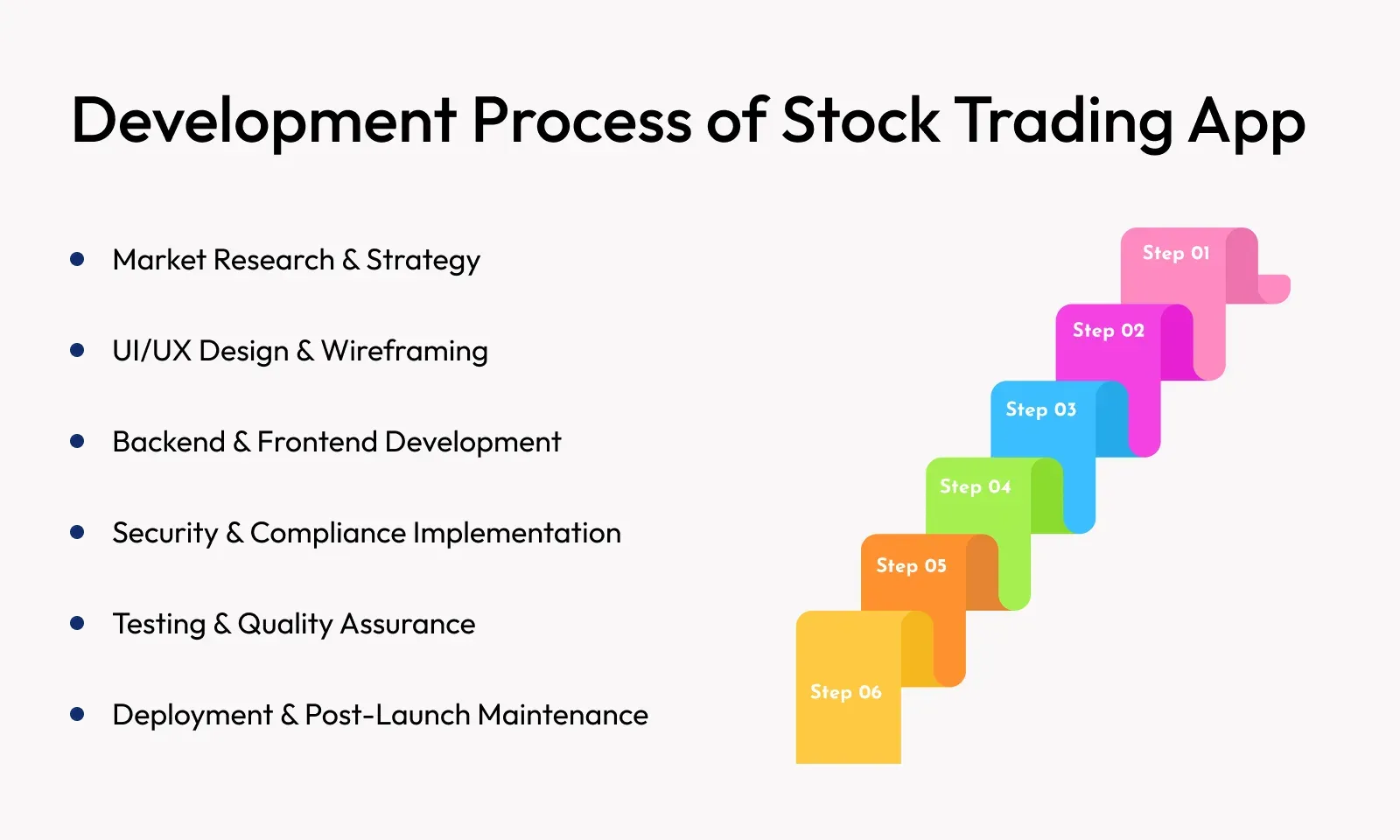
Step 1: Market research & strategy
Before diving into development, it's crucial to analyze the target audience, competition, and regulatory requirements. Key activities:
- Identifying user needs (retail traders, institutional investors, or both).
- Studying competitors like Zerodha, Upstox, Groww, Robinhood, etc., to understand their strengths.
- Ensuring compliance with SEBI (India) regulations.
- Choosing the monetization model (commission-based, subscription, or hybrid).
Step 2: UI/UX design & wireframing
A stock trading app must offer a clean, intuitive, and responsive design for both beginners and professional traders. Key activities:
- Creating wireframes and user flow diagrams.
- Designing a minimalist, clutter-free UI with easy navigation.
- Incorporating dark mode, high-contrast charts, and real-time market data visualization.
- Ensuring mobile and web responsiveness for multi-platform accessibility.
Step 3: Backend & frontend development
The core development stage involves integrating trading engines, APIs, payment gateways, and security layers. Key activities:
- Building a secure and scalable architecture with Node.js, Java (Spring Boot), or Python (Django/FastAPI).
- Integrating market data APIs (Alpha Vantage, Bloomberg, Yahoo Finance).
- Implementing real-time trading order execution with ultra-low latency.
- Developing secure authentication (OAuth, 2FA, biometric login).
- Creating a React Native (cross-platform) or Swift/Kotlin (native) mobile app.
- Implementing real-time stock charts, portfolio dashboards, and interactive trading UI.
- Ensuring seamless connectivity with the backend for instant order execution.
Step 4: Security & compliance implementation
Since trading apps handle sensitive financial data, security and regulatory compliance are non-negotiable. Key activities:
- Implementing AES encryption for transactions.
- Enforcing SEBI regulations, AML compliance, and secure KYC verification.
- Setting up real-time fraud detection and risk monitoring.
- Conducting penetration testing and vulnerability assessments.
Step 5: Testing & quality assurance
A stock trading app must function flawlessly under high-load conditions while ensuring bug-free performance. Key activities:
- Unit & integration testing to verify order execution, charting accuracy, and real-time data feeds.
- Performance testing to ensure the app handles high trading volumes with ultra-low latency.
- Security audits for running penetration tests to identify vulnerabilities.
- Beta testing by releasing an MVP to a closed group of users for feedback.
Step 6: Deployment & post-launch maintenance
After launch, continuous monitoring and updates are essential to ensure high performance and user retention. Key activities:
- Deploying the app on Play Store (Android) & App Store (iOS).
- Monitoring system uptime and fixing any live issues.
- Implementing new features based on user feedback.
- Scaling infrastructure as the user base grows.
A well-planned development process ensures that your stock trading app is secure, fast, and feature-rich, giving users the best possible trading experience. Partnering with the right fintech development team can significantly reduce risks and accelerate your time-to-market.