






Leveraging the right technology can be a game-changer for your business. Imagine trying to run a modern business with outdated tools—it’s like using a flip phone in an era of smartphones. So, to create tailor-made solutions for your business, custom software development comes into the frame. But why should businesses invest in custom software instead of opting for off-the-shelf solutions? How can different industries benefit from it? What are the crucial factors businesses must consider before developing custom software? In this blog, we are going to explain and give answers to all your questions and more, giving you a complete picture of custom software development in 2026.

Software development7 mins read
Custom Software Development: Types, Benefits, Solution Development
Published on: Jun 9, 2026

Table of contents
IntroductionCustom software market size and trends – A 2026 outlookWhat is custom software development?Key differences between custom and off-the-shelf software developmentWhy should businesses go for custom software development?Benefits of custom software development for businessesWhat types of businesses need custom software?Essential considerations for developing custom softwareHow do we develop custom software for your businesses?How can Evoqins help businesses with custom software development?ConclusionFrequently asked questions
Share this article:
Introduction
Custom software market size and trends – A 2026 outlook
The custom software development industry is expanding rapidly due to the increasing demand for personalized business solutions. According to market research, the industry is expected to reach $ 206.61 billion by the end of 2031-32, growing at a CAGR of 21.9% from 2025 to 2032. Here are some key market trends driving growth in 2026:
- AI and automation integration: Businesses are looking for software that can automate repetitive tasks and leverage artificial intelligence for better decision-making.
- Cloud-based solutions: The shift to cloud computing ensures better scalability and security.
- Cross-platform development: Companies now prefer software that works seamlessly across desktop, mobile, and web platforms.
- Cybersecurity investments: Custom software development now includes robust security protocols to protect sensitive business data.
With these trends, it’s evident that businesses need custom solutions to stay ahead of their competition. Get ready to discover the power of custom software development! Let's explore why it is essential for businesses, the benefits of using customized software, and how to find the perfect partner to create a tailor-made solution.
What is custom software development?
Custom software development is creating unique software solutions developed to meet the specific objectives of a particular business. Unlike off-the-shelf software packages, custom software is designed from scratch to address specific challenges and requirements. This type of development involves a close collaboration between the development team and the client.
Key differences between custom and off-the-shelf software development
| Feature | Custom software | Off-the-shelf software |
|---|---|---|
| Customization | Fully tailored to business needs | Limited customization options |
| Scalability | Grows with the business | It may require costly upgrades |
| Security | Higher security with custom protection | More vulnerable to widespread attacks |
| Cost | Higher upfront investment | Lower initial cost but may require additional expenses over time |
| Competitive advantage | Unique solutions that set the business apart | Generic features available to all competitors |
For businesses that are looking for unique functionalities and seamless integrations, custom software development is the way to go.
Why should businesses go for custom software development?
Custom software is developed with a comprehensive understanding of the business's workflows, goals, and objectives, providing a highly tailored solution to optimize its operations. Here are some pointers to consider custom software development for your business.
- Tailored to your business needs: Traditional software needs to catch up when addressing individual businesses' unique challenges and requirements. Custom software development allows them to create a solution that aligns perfectly with any company's workflow.
- Increased efficiency and productivity: Custom software is designed to fit into existing workflows, eliminating unnecessary complexities and reducing manual effort. It can significantly improve efficiency and productivity, allowing you to focus on business strategies by automating redundant tasks and integrating various systems.
- Be top on the list: Standing out for success in a highly competitive marketplace is essential to hold the torch of your business high. Custom software development allows clients to differentiate their businesses with customized features and functionalities. This competitive advantage can enhance customer satisfaction, attract new clients, and drive business growth.
- Scalability and flexibility: Custom software development ensures the features and functionalities grow and evolve alongside your business. Whether expanding into new markets, adding new product lines, or accommodating increasing customer demands, custom software can be adapted and scaled to support your evolving needs, saving you from the limitations of generic software solutions.
Benefits of custom software development for businesses
Any business seeking to optimize its operations, improve efficiency, address unique challenges, or gain a competitive edge can benefit from custom software development. With software specifically tailored to their needs, businesses will unlock their full potential and achieve their goals more effectively.
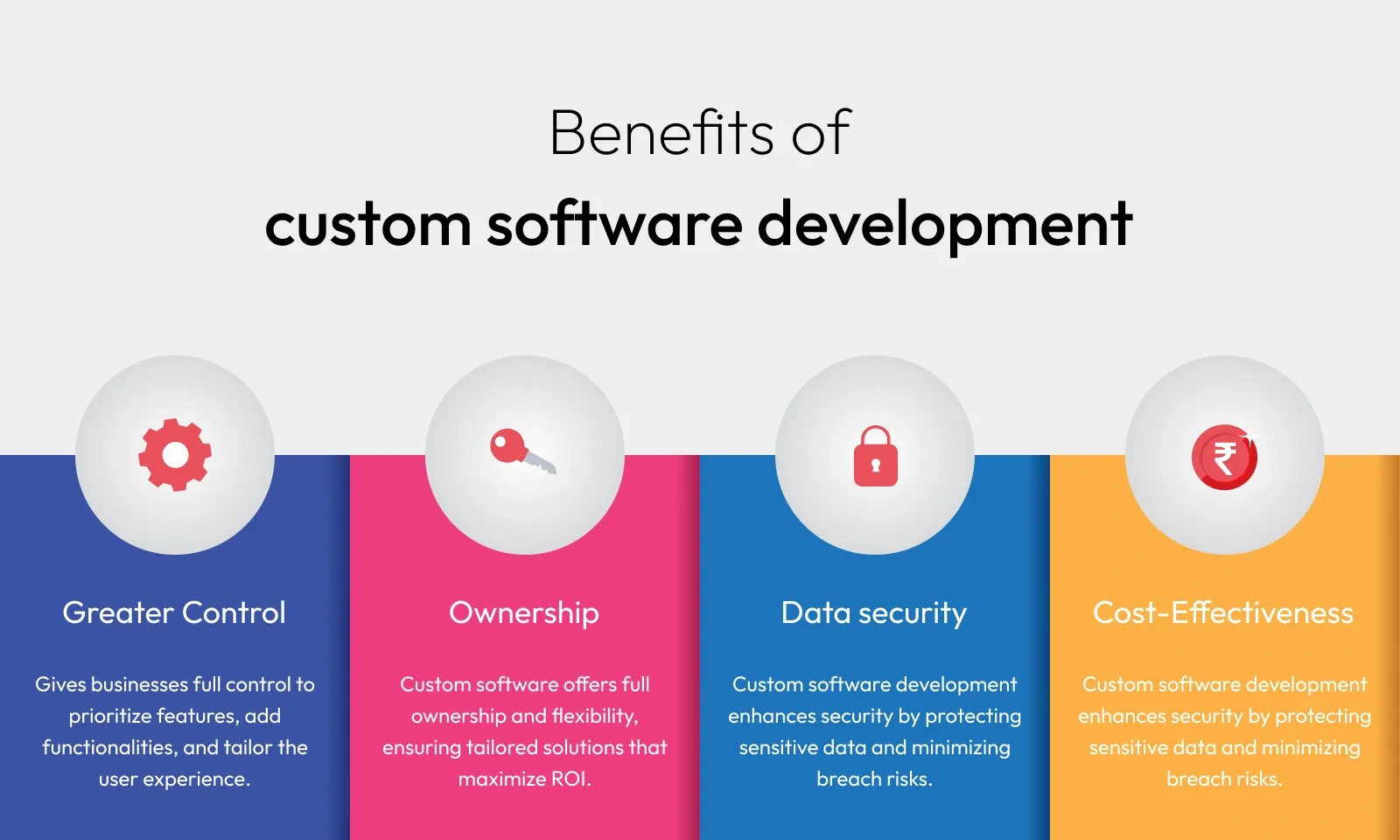
- Greater control: With custom software, businesses have complete control over the software development process, enabling them to prioritize features, incorporate specific functionalities, and shape the user experience according to their vision.
- Ownership: Custom software provides complete ownership, giving clients the freedom to make changes as per their business necessities. Unlike off-the-shelf software, it is tailored to their specific needs, ensuring that it meets their business objectives and offers maximum ROI.
- Enhanced data security: Custom software development allows clients to implement solid security measures tailored to their business, protecting sensitive data and reducing the risk of breaches and unauthorized access.
- Cost-Effectiveness in the long run: Custom software eradicates the demand for multiple software applications, reducing licensing fees, ongoing subscription costs, and potential inefficiencies associated with generic software.
What types of businesses need custom software?
Custom software can benefit businesses across various industries. Here are a few types of businesses that can benefit from custom software:
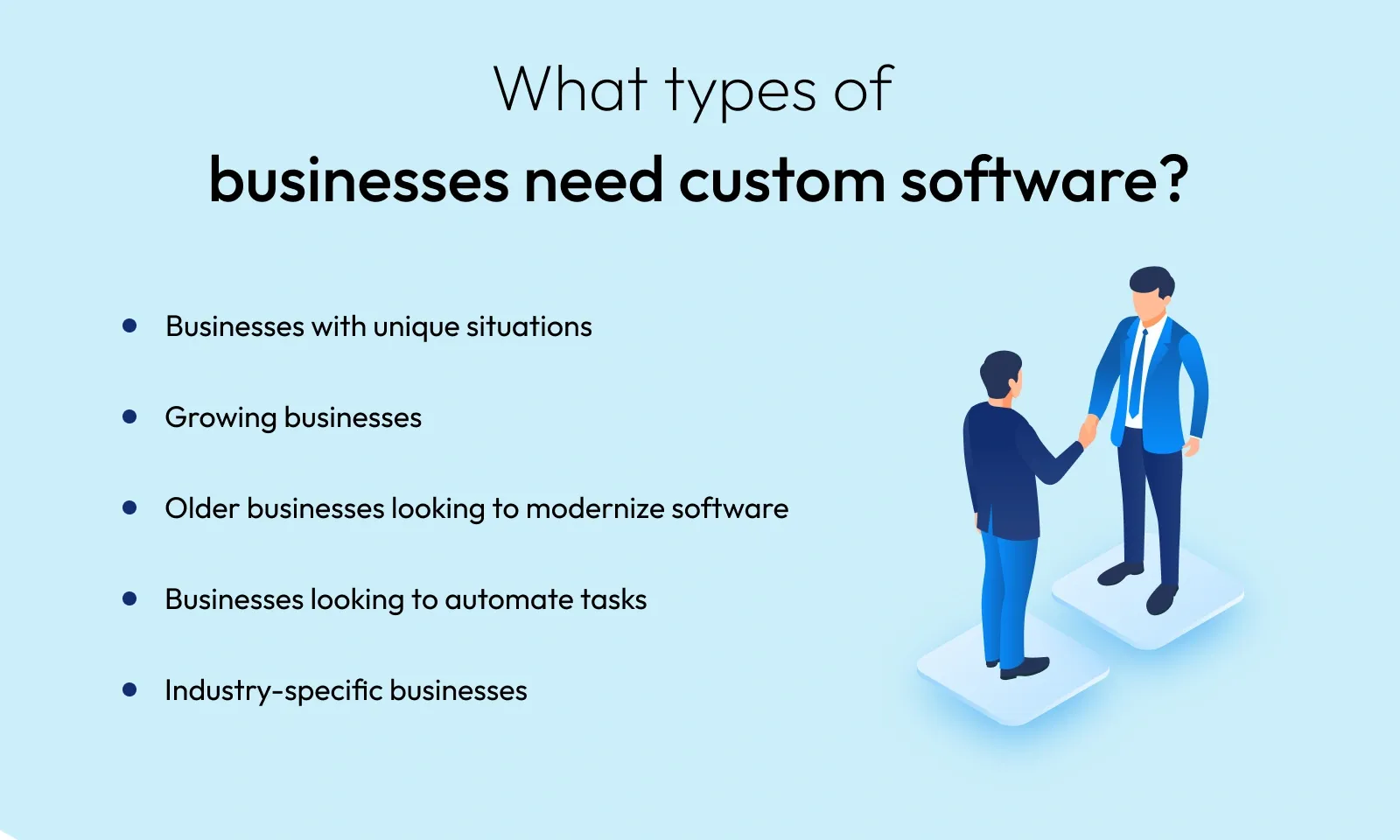
- Businesses with unique situations: Some businesses have unique and specific needs that pre-made software cannot address. Custom software is designed to meet these particular requirements and challenges. For instance, healthcare providers may need custom software to ensure compliance with industry regulations when managing electronic health records (EHR). Additionally, logistics companies may require custom software to streamline complicated supply chain operations.
- Growing businesses: As a business grows, its software requirements become more intricate. Custom software can meet the changing needs of expanding businesses by offering scalable solutions that can adjust to growing data volumes, user numbers, and operations. It allows businesses to have software that can evolve with them, avoiding the limitations and inefficiencies of generic software.
- Older businesses looking to modernize software: Your business must modernize its infrastructure with the latest technologies and features if you are still using outdated software. Developing custom software is the solution if you require additional help with its functionality, integration capabilities, or user experience. It will improve efficiency, reduce costs, and enhance employee and customer user experience.
- Businesses looking to automate tasks: Automation is a key driver of efficiency and productivity in today's business landscape. Custom software can help businesses automate manual and redundant tasks, freeing up valuable time for the tech crew to concentrate on more strategic and value-added activities. For example, a customer service-oriented business may develop a custom software solution to automate ticket management and response, streamlining customer support processes.
- Industry-specific businesses: Certain industries have unique requirements that off-the-shelf software cannot fully address. For instance, financial institutions may require custom software to meet regulatory compliance and security standards. Custom software development enables businesses in such industries to have personalized solutions that align with their specific industry demands.
If you want to know more about custom software development and the benefits of it for your business, head over to our portfolio page to see our successful projects.
Essential considerations for developing custom software
Before diving into custom software development, businesses must consider several critical factors to ensure successful project execution. Here are some specific questions for which you need to find answers:
- What specific problems will the software solve for users?
- What features and functionalities are essential to develop a problem-solving solution?
- How will the custom solution integrate with your existing systems, or how will it bring more revenue to your business?
Choosing the right custom software development company is essential for project success. Assess these factors to find a company that aligns with your business requirements, goals, and vision. It will lead to a successful partnership and high-quality software. Key considerations includes:
- Expertise and experience: Evaluate the company's technical expertise, industry familiarity, and the quality of their previous projects. Ensure they are proficient in your project's technologies and programming languages. Look for certifications, industry recognition, or partnerships with technology providers that demonstrate their expertise.
- Development process and methodology: Inquire about the company's development process and methodology. Ensure that the company's development process aligns with your project's requirements and allows for incremental development, regular updates, and transparent project management.
- Project management and support: Evaluate the project, time, and budget management skills. Additionally, asking about their support and maintenance services after the software is deployed is recommended. Consistent support is essential for tackling any issues, providing updates, and ensuring the long-term success of your software solution.
- Cost and value: It is essential to consider the pricing model and value for money offered by the custom software development company. Compare quotes, evaluate the cost of ongoing support and maintenance, and consider the long-term benefits and ROI that the software solution can provide.
- Client reviews and reputation: Research the company's reputation and seek out client reviews and testimonials. Websites, industry forums, and social media can offer insights into the experiences of their past clients. Positive reviews and a robust reputation indicate a reliable and trustworthy software development partner.
How do we develop custom software for your businesses?
Developing custom software is like constructing a house—you need a solid blueprint, the right materials, skilled workers, and continuous maintenance to keep it in top shape. A well-structured software development process ensures that businesses get a high-quality, reliable, and scalable product that fits their specific needs. Here’s a detailed breakdown of the six essential stages of custom software development:
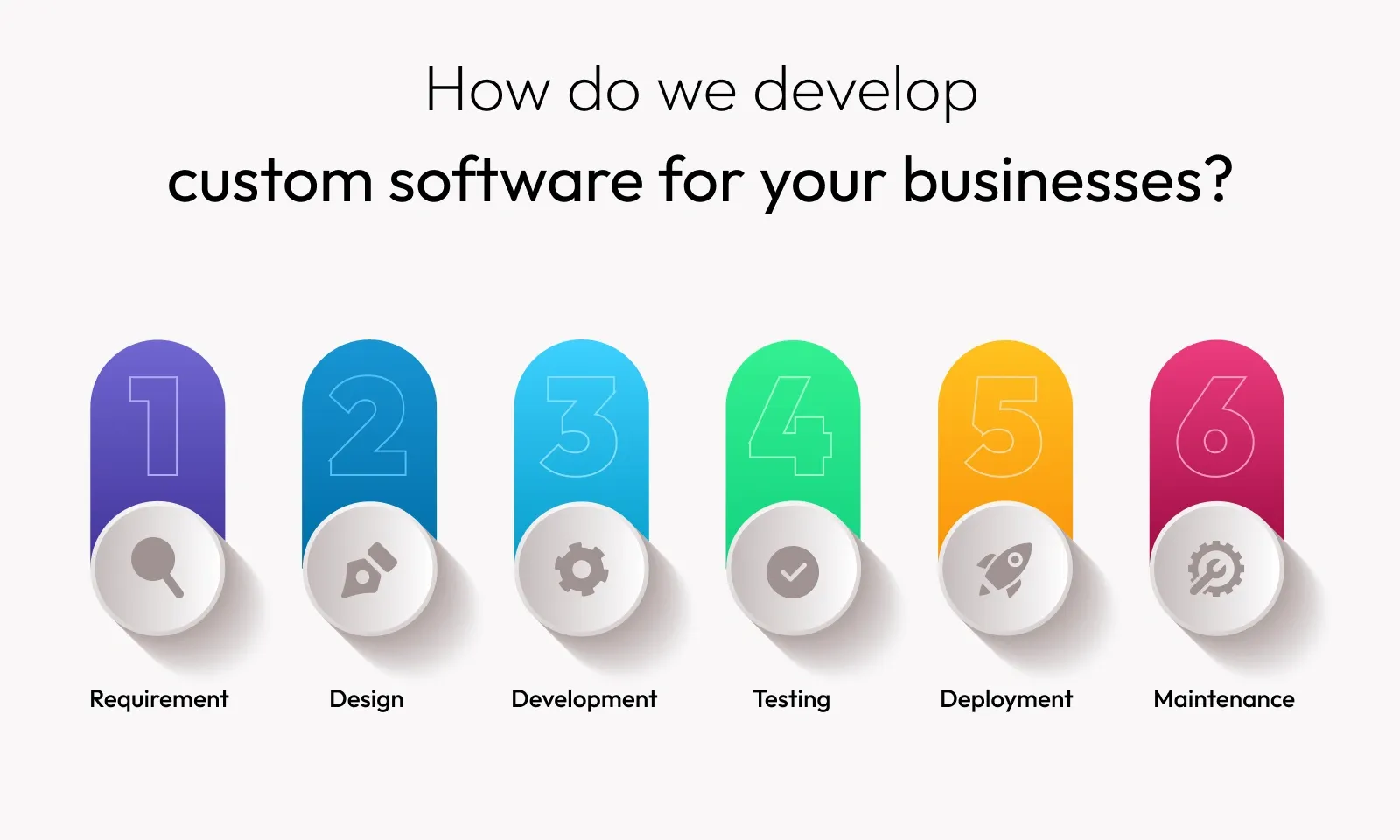
⇒ Requirement analysis – Understanding business needs
Before developers write a single line of code, they must fully understand the business goals, challenges, and expectations for the software. This step involves deep discussions with stakeholders, employees, and end-users to gather essential information about:
- Business processes and pain points – What problems is the software solving?
- Key functionalities required – What features should be included?
- Integration with existing systems – Does the new software need to work with current tools (e.g., CRM, ERP, payment gateways)?
- Regulatory compliance – Does the software need to follow industry standards (e.g., GDPR, HIPAA)?
How does a business benefit from requirement analysis?
A logistics company wants custom software to track delivery routes in real time. In the requirement analysis phase, developers discover that drivers struggle with route optimization, causing delays and extra fuel costs. The business needs:
- A real-time GPS tracking system
- An AI-powered route optimization feature
- Integration with existing inventory management software
This phase ensures that the final product directly addresses the company’s challenges and improves efficiency.
⇒ Design – Creating the blueprint
Once the requirements are clear, designers create a visual and technical blueprint of the software. It includes:
- Wireframes and mockups – Visual representations of the software’s interface (how it will look and function)
- User experience (UX) design – Ensuring that users can navigate the software easily
- Database design – Structuring how data will be stored, accessed, and secured
- System architecture planning – Defining how different software components will interact
Importance of good design in a business application
A retail business developing an e-commerce platform wants a seamless user experience. In the design phase, developers create:
- A simple and intuitive checkout process to reduce cart abandonment
- Personalized product recommendations based on browsing history
- A mobile-friendly design to attract smartphone shoppers
A well-designed system ensures better usability, efficiency, and long-term success.
⇒ Development – Building the software
It is where developers start writing code to bring the design to life. It involves:
- Front-end development – Creating the visual parts users interact with
- Back-end development – Building the engine that powers the software (database, servers, APIs)
- Feature implementation – Adding functionalities like login systems, dashboards, reports, and automation
- Security measures – Implementing encryption, user authentication, and cybersecurity best practices
How does a business benefit from custom software development services?
A financial services company needs custom software to analyze real-time stock market data. The development team:
- Builds an AI-powered data processing system for real-time analytics
- Ensures high-speed processing to handle thousands of transactions per second
- Integrates multi-factor authentication (MFA) for security
A custom-built solution allows businesses to have features that off-the-shelf software simply cannot provide.
⇒ Testing – Ensuring the software works perfectly
Once the software is developed, it must be thoroughly tested to catch and fix any issues before launch. This phase includes:
- Functional testing is conducted to ensure all features and functionalities work as intended.
- Performance testing to check how the software performs under heavy usage
- Security testing to identify vulnerabilities to prevent cyber threats
- User acceptance testing (UAT) to let the real users test the software and provide feedback
How does testing prevent business disruptions? A healthcare company is launching a patient appointment scheduling system. During testing, they discover:
- Some appointments are getting double-booked – fixed with an improved scheduling algorithm
- The mobile app crashes on certain devices – resolved through debugging
- Some patient data isn’t encrypted properly – fixed by enhancing security measures
Thorough testing ensures that businesses avoid costly issues and maintain customer trust.
⇒ Deployment – Launching the software for business use
After successful testing, the software is installed and launched for real-world use. It involves:
- Server setup and software installation – Ensuring the software runs smoothly on company systems or the cloud
- Data migration – Transferring existing business data into the new system
- Employee training – Teaching staff how to use the new software effectively
- Gradual rollout or full-scale launch – Some businesses prefer a phased rollout to minimize disruptions
Successful deployment in a business setting
A restaurant chain is launching a custom POS (Point-of-Sale) system to handle orders and payments.
- The system is first tested in one location before rolling out company-wide
- Staff are trained on how to process transactions using the new software
- Data from the old POS system is migrated to ensure a smooth transition
Proper deployment ensures a smooth software launch without disrupting daily operations.
⇒ Maintenance – Keeping the software updated and secure
Software development doesn’t end after deployment. To keep the software reliable, secure, and up to date, businesses need ongoing maintenance, which includes:
- Bug fixes – Addressing unexpected issues that arise over time
- Performance optimization – Ensuring the software runs efficiently as business needs evolve
- Security updates – Protecting against new cyber threats
- Feature enhancements – Adding new capabilities based on user feedback
The importance of maintenance in business software development
A real estate agency uses a custom property management system. Over time, they:
- Expand their business to multiple locations – requiring software scalability
- Notice slower system performance due to increased data – resolved with performance tuning
- Implement new digital marketing strategies – need an integration with CRM software
Ongoing maintenance keeps software relevant, secure, and aligned with evolving business goals.
How can Evoqins help businesses with custom software development?
Evoqins specializes in building custom software development using cutting-edge technologies, such as React, Node.js, MongoDB, etc. We have experienced tech team members who work closely with every business client to deliver solutions that meet their expectations.
- We prioritize transparent communication throughout the development lifecycle, ensuring that clients are kept up-to-date about the progress of their project, including any challenges that may arise on adjustments to the plan. Clear documentation, regular updates, and open dialogue contribute to transparency.
- A focus on innovation could mean that Evoqins is committed to staying abreast of cutting-edge technologies and trends in the software development industry. They may bring creative and novel solutions to address clients' unique challenges, fostering a culture of continuous improvement and forward-thinking.
- Evoqins showcases its expertise through a team of skilled professionals with diverse technical backgrounds. It is demonstrated through successful project execution, expertise in solving complex problems, and understanding of various industries and technologies.
- Demonstrating commitment involves delivering on promises, meeting deadlines, and going beyond the expectation to ensure client satisfaction. Evoqins could emphasize its dedication to the success of each project, putting in the effort required to achieve the agreed-upon goals.
- Reliability is key in custom software development. Evoqins focuses on providing stable and dependable solutions. It includes rigorous testing, quality assurance measures, and ongoing support to ensure the reliability of the software throughout its lifecycle.
- Collaboration is likely a fundamental aspect of Evoqins' approach. They may engage clients in a collaborative development process, seeking and incorporating feedback and working like a partner with clients to ensure that the software aligns with the business vision and goals.
Conclusion
With the rapid advancements in technology, having a solution tailored specifically to your needs can improve efficiency, streamline operations, and enhance customer satisfaction. Unlike off-the-shelf software, custom solutions evolve with your business, ensuring scalability and long-term growth. Opting for custom software development allows businesses to integrate cutting-edge technologies, optimize workflows, and eliminate unnecessary bottlenecks.
Finding the right software development partner is important for businesses looking to improve their digital presence with end-to-end digital product development. Evoqins is a great choice because it focuses on its clients' needs and offers high-quality custom software solutions. They take the time to understand your specific requirements and create personalized applications that can help your business grow and innovate. Whether you’re just starting or you have an established company, investing in custom software could be the key to taking your business to the next level.
Let Evoqins, the wizards of custom software, be your trusted guide on this enchanting journey. Contact us today to forge a future where your business reigns supreme, captivating customers and leaving a legacy that echoes through time.
Frequently asked questions
1. How can custom software help my business grow?
Custom software development aligns with your business processes, automates repetitive tasks, and enhances efficiency. It helps reduce operational costs, improves customer experience, and provides scalable custom solutions that grow with your company. Businesses using custom software often see higher productivity, better decision-making with data insights, and increased customer retention.
2. Is custom software development worth the investment for small businesses?
Yes. While the upfront cost may be higher, custom software eliminates recurring licensing fees, improves operational efficiency, and prevents costly workarounds required by off-the-shelf solutions. Many small businesses may see a return on investment within the first few years as the custom software decreases manual work.
3. What happens if my business needs changes or upgrades in the future?
Custom software is highly scalable, meaning new features and updates can be added as your business grows. A reputable development team will offer the following:
- Ongoing maintenance and support
- Version upgrades based on business expansion
- Performance optimization as user traffic increases
4. How do I choose the right custom software development company for my business?
When selecting a software development partner, consider:
- Experience in your industry (e.g., fintech, healthcare, retail)
- A strong portfolio of previous projects
- Client testimonials and reviews (Check Clutch, Google reviews)
- Transparent pricing and flexible engagement models
- Post-development support and maintenance services
5. How can you calculate the ROI of custom software for your business?
Businesses can measure ROI by comparing:
- Time saved on manual processes vs. software automation
- Reduction in operational costs (fewer workarounds, less human error)
- Increase in revenue from better customer engagement and faster service delivery
- Competitive advantage gained through unique features
Many businesses report a positive ROI within 12-24 months after implementing custom software.



Subscribe and keep updated
Get weekly update about our product on your email, no spam guaranteed we promise ✌️